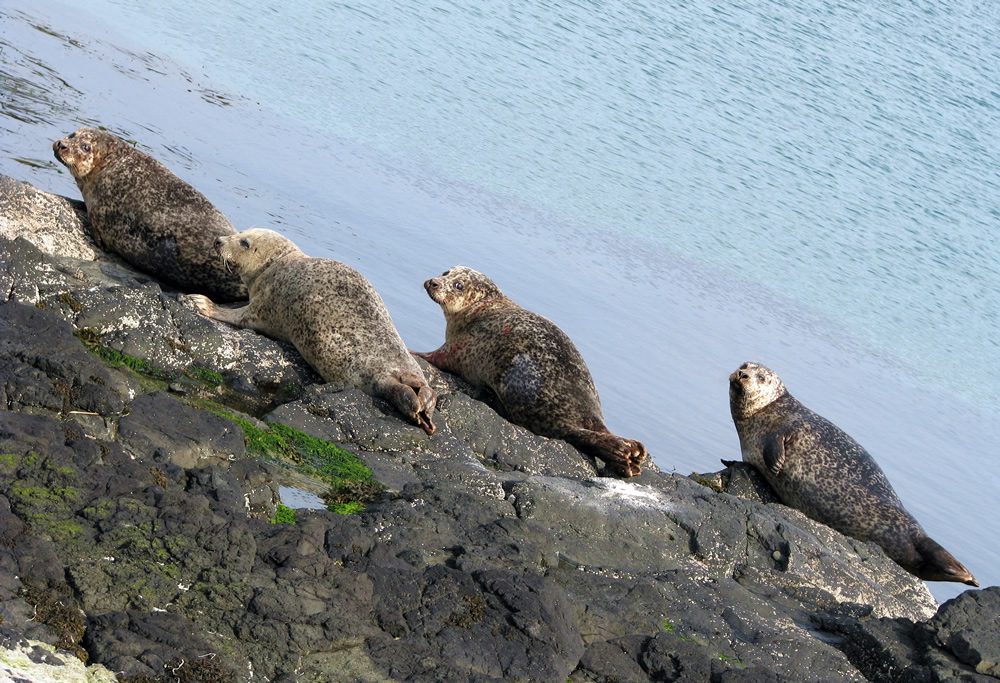
Grey seals on Rathlin Island: Where and When to See Them
Most visitors come to Rathlin Island for the puffins. Many leave having been equally enchanted by an encounter with the island’s grey seals. These large, expressive marine mammals — hauled out on favourite rocks along the coast, swimming in Church Bay, or surfacing unexpectedly beside the ferry — are one of the most rewarding wildlife experiences Rathlin has to offer, and unlike the puffins they are present year-round.
About Grey Seals
The grey seal (Halichoerus grypus) is the larger of the two seal species found around Rathlin Island — the other being the common (or harbour) seal (Phoca vitulina). Adult male grey seals can reach 2.5 metres in length and weigh up to 300 kilograms, while females are considerably smaller. They are characterised by their distinctive grey colouring (which varies considerably between individuals), their large dark eyes, and the males’ pronounced Roman-nosed profile.
Grey seals are the most numerous large wild mammal in the British Isles, with around 40 percent of the world’s grey seal population found in UK and Irish waters. Nevertheless, an encounter with a grey seal in the wild remains a genuinely special experience — they are curious, intelligent animals, and interactions with them in the water (for divers and snorkellers) or on the shore can be remarkable.
Where to See Grey Seals on Rathlin Island
Church Bay
The most accessible place to see seals on Rathlin Island is right at Church Bay itself, where the ferry docks. Seals regularly haul out on the rocks around the bay and are frequently visible from the harbour wall and the small beach. On a calm day, you may spot the rounded heads of seals watching you from the water as you walk along the shore — their large, liquid dark eyes seemingly as curious about you as you are about them.
Rocky Shores on the North and West Coasts
Grey seals favour the more exposed rocky shores of Rathlin’s north and west coasts for hauling out. These areas are less easily accessed than Church Bay, but visitors walking to or from the RSPB West Light Seabird Centre may spot seals on the rocks below the cliffs. Binoculars are useful for viewing seals at these more distant haul-out sites without disturbing them.
From the Ferry
Keep your eyes on the water during the ferry crossing between Ballycastle and Rathlin. Grey seals are regularly spotted in the North Channel, and the approach to Church Bay often provides views of seals on rocks near the harbour entrance.
Underwater
For scuba divers and snorkellers, grey seals around Rathlin Island offer one of the finest marine mammal encounters available in the British Isles. The seals are accustomed to divers and are often remarkably bold — approaching to examine equipment, following divers along the seabed, and occasionally engaging in extended interactive sessions. These encounters must always be on the seal’s terms; never chase or attempt to touch a seal underwater.
When Are Seals Most Visible?
Grey seals can be seen around Rathlin Island throughout the year. However, certain times are particularly good for seal watching:
Autumn (September – November) — Pupping Season
Autumn is the most exciting time for grey seal watching around Rathlin. This is the breeding season — bulls (males) gather on and around haul-out sites, competing for access to females. Cows (females) give birth to white-coated pups from October onwards. Pups are born helpless and nurse from their mothers for about three weeks before being abandoned and left to fend for themselves — a harsh but effective strategy. Seeing a newborn grey seal pup is one of the great wildlife experiences of the British Isles.
Winter (December – March)
Following the pupping season, grey seals are well fed and often numerous around Rathlin’s shores. Winter visits to the island may have fewer tourist-focused activities, but the seal watching can be outstanding.
Summer
Seals are present in summer too, though numbers may be lower as individuals disperse. Sightings in Church Bay and from the ferry remain regular throughout the visitor season.
How to Watch Seals Responsibly
Grey seals are wild animals and should be treated with respect and given appropriate space. The following guidelines help ensure that your seal watching does not cause stress or harm to the animals:
- Keep your distance on land: If you encounter seals hauled out on rocks, stay at least 50 metres back. Seals that feel threatened will enter the water unnecessarily, wasting energy they need for breeding or pup-rearing.
- Never approach seal pups: A lone pup on a beach is not necessarily abandoned — the mother may be at sea feeding. Do not approach, touch or attempt to help pups unless you have reason to believe they are genuinely injured or ill.
- Keep dogs away: Dogs should be kept on a lead and well away from seal haul-out sites. Even a dog at a distance can cause seals to panic and enter the water.
- Move slowly and quietly: Loud noises and sudden movements near seals cause unnecessary stress. Move slowly and quietly when approaching viewing areas.
- Underwater: Never chase seals or attempt to touch them underwater. Allow them to approach you on their own terms.
Common Seals on Rathlin
Common (harbour) seals are also present in the waters around Rathlin Island, though less numerous than grey seals. They are smaller than grey seals, with a more dog-like face and shorter, more rounded head profile. Common seals give birth in summer (June to July) rather than autumn, and their pups are able to swim from birth — a key difference from the helpless, shore-bound grey seal pups. Both species can sometimes be seen at the same haul-out sites around Rathlin.