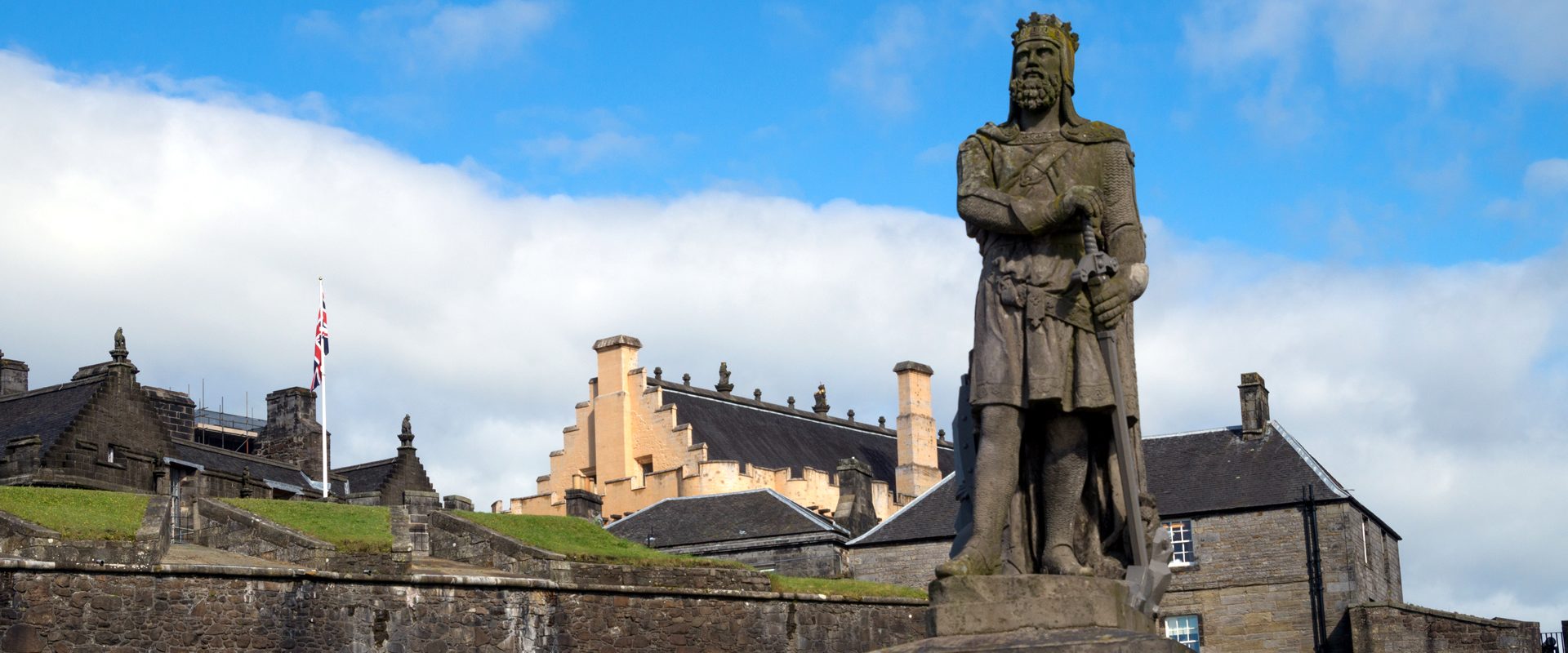
The Legend of Robert the Bruce and the Spider: Rathlin Island’s Most Famous Story
Of all the stories associated with Rathlin Island — and there are many, spanning seven thousand years — none has captured the world’s imagination quite like the legend of Robert the Bruce and the spider. It is one of the most famous tales of perseverance and resilience in all of history, and its setting is a cave on the eastern cliffs of this small island off the north Antrim coast.
Who Was Robert the Bruce?
Robert the Bruce — or Robert I of Scotland, to give him his full title — was one of the most significant figures in Scottish and British history. Born in 1274 to a noble family with claims to the Scottish throne, Bruce lived through one of the most turbulent periods in Scottish history: the Wars of Scottish Independence against English rule under King Edward I.
Bruce was a complex and sometimes contradictory figure. He changed sides multiple times during the wars, at various points supporting both the Scottish and English causes. But in 1306, he made a decisive commitment. He had himself crowned King of Scots at Scone in March of that year — an act of open defiance against English authority.
Defeat and Exile
The crowning did not go smoothly. Within months, Bruce had suffered a series of devastating military defeats. His forces were scattered, key supporters were captured and executed, and members of his own family were taken prisoner by the English. By the autumn of 1306, Bruce was a fugitive king with no kingdom — hunted, defeated and forced to flee.
With few options remaining on the Scottish mainland, Bruce looked across the sea. The western isles and the coast of Ireland offered potential refuge, and the short crossing to Rathlin Island — just 15 miles from the Mull of Kintyre — provided exactly the kind of remote, defensible hiding place he needed.
The Cave on Rathlin Island
Bruce and a small group of followers sought shelter in a cave on Rathlin’s eastern cliffs. The cave — known today as Bruce’s Cave — is accessible from the eastern end of the island, not far below the East Lighthouse. It is a modest cave by any objective measure, but its setting is dramatic: perched above the churning waters of the North Channel, with the Scottish coast clearly visible on the horizon.
Here, according to the famous legend, Robert the Bruce spent time during the winter of 1306 to 1307 in a state of profound dejection. He had failed. His army was broken. His bid for the Scottish crown seemed hopeless. He was considering abandoning the struggle entirely.
The Spider and the Web
It was in this low moment that Bruce noticed a small spider attempting to spin its web in the cave entrance. The spider was trying to attach its thread to a rocky outcrop — and failing. Again and again it tried, swinging out on its thread and missing the target. Each time it fell back and started again.
Bruce watched, transfixed. Six times — some versions of the legend say seven — the spider failed. And six times it started again. On its seventh attempt, the spider succeeded, attaching its thread and beginning to spin its web.
The effect on Bruce was profound. Here, in the simplest possible terms, was a lesson in perseverance that the discouraged king took to heart. If a spider could try and fail six times and still succeed on the seventh, so could he. He resolved to return to Scotland and continue the fight.
The Return and Bannockburn
In the spring of 1307, Robert the Bruce left Rathlin Island and returned to Scotland. The campaign he launched was slow and grinding — Edward I of England died in 1307, which helped, but the struggle continued for years. Bruce rebuilt his support, gradually reconquered Scottish territory, and consolidated his hold on the kingdom.
The defining moment came on 23 and 24 June 1314 at the Battle of Bannockburn, near Stirling. Bruce’s Scottish army defeated a much larger English force under Edward II in one of the most significant battles in British history. Scottish independence was effectively secured.
How Much of the Legend is True?
Historians have debated the spider legend for centuries. What is historically established is that Robert the Bruce did indeed spend time in the western isles and on the Irish coast during his period of exile in 1306 to 1307. Several contemporary and near-contemporary sources place him in the area of Rathlin Island during this period.
The spider story itself first appears in written sources in the early 14th century, and variants of it have been told ever since. Whether Bruce literally watched a spider and drew the specific lesson described is impossible to verify. What is clear is that he left his exile renewed in determination and went on to achieve one of the greatest reversals of fortune in medieval history.
Visiting Bruce’s Cave Today
Bruce’s Cave can be visited on Rathlin Island today. It is located on the island’s eastern cliffs, below the East Lighthouse. The path to the cave requires some scrambling and appropriate footwear is recommended. The cave itself is relatively modest, but the setting — dramatic cliffs, the sound of the sea below, and Scotland clearly visible across the water — makes it a genuinely atmospheric place to visit.
Standing at Bruce’s Cave and looking across the North Channel towards the Mull of Kintyre, it is easy to imagine the exiled king watching the same view, gathering himself for the return that would change the course of history.