The History of Rathlin Island
For such a small island — barely seven miles from end to end — Rathlin Island has witnessed an extraordinary amount of history. Its story spans more than 7,000 years, from the very first human settlers who crossed from Scotland in the Neolithic era, through Viking raiders, medieval clan warfare, colonial massacre, and ownership disputes between two nations, right up to the resilient island community of today.
Rathlin’s position in the North Channel, sitting between Ireland and Scotland, has made it strategically significant throughout history. It has been fought over, raided, settled, abandoned and resettled — and every era has left its mark on the island’s landscape, culture and character.
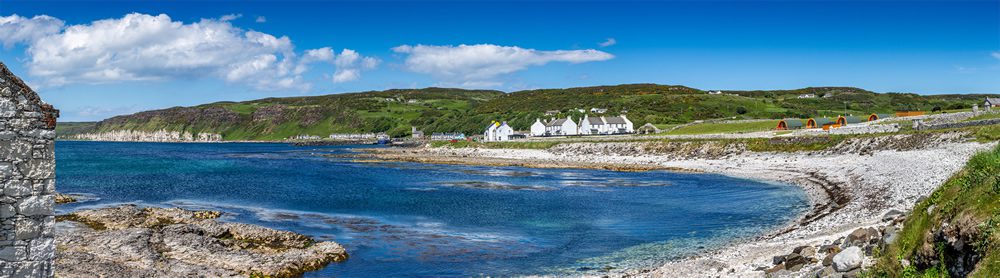
A Timeline of Rathlin Island History
Neolithic Period (5,000 – 6,000 BC)
Archaeologists believe Rathlin Island was one of the very first Irish islands to be inhabited, with settlers arriving somewhere between 5,000 and 6,000 BC. These early arrivals most likely came across from the Scottish coast, which is clearly visible from the island on a fine day. Rathlin’s Neolithic inhabitants established what was effectively a stone tool factory on the island, producing distinctive porcellanite axes that have since been found at sites across Europe and the United Kingdom — remarkable evidence of how connected even these early island communities were with the wider world.
The First Viking Raid in Ireland (795 AD)
Rathlin Island holds a grim distinction in Irish history: it was the site of the very first recorded Viking raid on Irish soil, which took place in 795 AD. The Vikings, attracted by the island’s exposed position and the monastery that had been established there, launched a devastating assault. It would not be the last — Rathlin suffered repeated Viking attacks over the following decades, and the island’s history is deeply intertwined with the Norse presence in the Irish Sea.
Robert the Bruce (1306)
Perhaps the most famous story associated with Rathlin Island concerns Robert the Bruce, who would go on to become King Robert I of Scotland. Defeated by the English in 1306, Bruce fled to Rathlin Island and took refuge in a cave — known today as Bruce’s Cave — on the island’s eastern cliffs. According to legend, it was here that he watched a spider repeatedly attempt to spin its web, failing again and again before finally succeeding. This simple act of perseverance inspired Bruce to continue his own struggle, and he returned to Scotland to ultimately win the Battle of Bannockburn in 1314. The cave can still be visited today, located near the East Lighthouse.
The MacDonnell Massacre (1575)
The darkest chapter in Rathlin’s history came in July 1575, during the Elizabethan conquest of Ulster. English forces under the command of the Earl of Essex launched a brutal attack on the island, killing several hundred people — including women, children and elderly members of the MacDonnell clan — who had taken refuge on Rathlin believing themselves to be safe. It was a deliberate act of colonial violence, and one that left deep scars on the island’s collective memory.
The Snake Test (1617)
Rathlin’s proximity to Scotland — just 15 miles from the Mull of Kintyre — led to centuries of ownership disputes between Ireland and Scotland. In 1617, authorities settled the matter with a distinctly unconventional test. Since St Patrick had supposedly banished all snakes from Ireland, a snake was released on Rathlin Island. If it survived, the island belonged to Scotland. If it died, Rathlin was Irish. The snake died — and Ireland’s claim to the island was confirmed.
The Kelp and Salt Industries (1700s – 1930s)
During the 18th and 19th centuries, Rathlin developed thriving kelp and salt industries. The island’s salt rocks at Pans Rocks on the eastern shore were used for evaporating salt, while kelp gathering and processing became a significant part of the island’s economy from the late 1700s until the 1930s. At its peak in the 19th century, Rathlin had a population of over 1,000 people.
Population Decline and the Modern Era
Like many island communities, Rathlin suffered significant population decline during the 19th and 20th centuries. From a peak of over 1,000 residents, the population fell to its current level of around 150. Today, the island’s community is actively working to sustain and grow its population, supported by tourism, farming, fishing and conservation work.